Thirty years of speed, code, maps, mods, LANs and rockets
The History of Quake

From id Software's risky leap into fully three-dimensional worlds in the mid-1990s to QuakeWorld, rocket jumping, Team Fortress, arena esports, source-code releases, Quake Live, Quake Champions, modern rereleases and the still-active mapping scene: this is a long-form history of how Quake became much more than one 1996 shooter.
Jump to a chapter
A thirty-year rabbit hole
Chapter 01 · 1991–1995
Before Quake: id Software learns to move faster than the industry
Quake did not appear out of nowhere in 1996. It was the next step in a run of increasingly aggressive technical bets by id Software, a studio founded in 1991. Commander Keen had demonstrated the team's ability to make PC hardware do things associated with consoles. Wolfenstein 3D then pushed a first-person action format into the mainstream of PC shareware. DOOM turned that formula into a networked, moddable, speed-driven phenomenon. By the time work on Quake intensified, id had already developed a company culture in which technology, tools, design and distribution could all be reconsidered between games instead of merely polished.
The importance of that prehistory is easy to miss because Quake looks, in retrospect, like the obvious successor to DOOM. It was not. DOOM's world was visually convincing but structurally constrained: floors and ceilings could not freely overlap in the way a general three-dimensional world demands, and most actors were rendered from sprite images rather than polygonal models. Quake set out to break those boundaries. That changed almost everything at once: rendering, collision, map construction, lighting, animation, networking, performance budgets, art production and the basic assumptions level designers could make.
John Romero has described id's use of NeXTSTEP systems as part of the studio's development advantage. id had moved its internal development environment onto NeXT systems before DOOM and continued using that workflow for Quake. The point was not that players needed exotic hardware; they did not. The point was that id's designers and programmers were building the game with a development environment they considered more productive, then targeting the enormous installed base of PCs. That separation between a powerful creation environment and a broadly accessible runtime would become normal across the industry.
Quake also began with a more unsettled identity than the finished game suggests. Romero's surviving notes and later recollections show that the name and concept existed before the final first-person shooter design hardened. In October 1995, people outside id were already compiling scattered statements, magazine comments and IRC discussion into Quake FAQs because interest was so intense and the design was still visibly changing. Romero later wrote that a major internal meeting in late 1995 settled the final direction that led to the game released the following June.
Chapter 02 · The hard middle
Becoming Quake: the design bends around the engine
Bleeding-edge technology rarely arrives in a neat package. Quake's engine opened possibilities but also imposed costs. True 3D spaces meant more expensive visibility calculations, more complicated maps, polygonal enemies, different animation requirements and a far more demanding renderer than DOOM. Designers who had become extremely fast at constructing DOOM maps had to learn how to think in volumes, vertical overlaps and polygon counts. Artists had to make low-polygon models and skins that would survive close inspection from arbitrary angles rather than selecting from a limited set of sprite rotations.
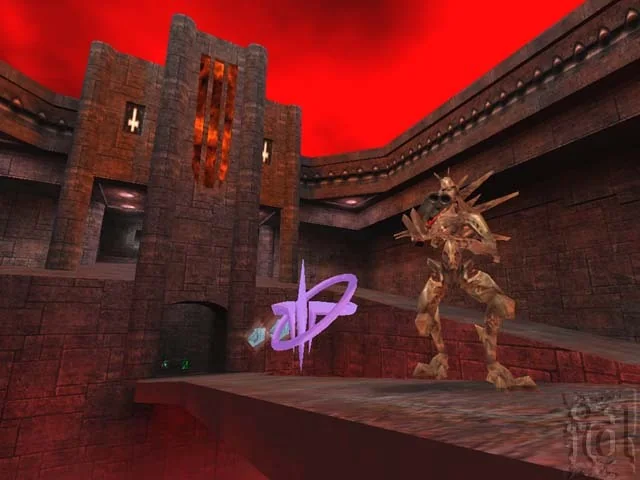
The finished game therefore emerged from a negotiation between ambition and what could actually be made fun, stable and fast on 1996 PCs. Its strange mixture of military bases, medieval fortresses, rusted machinery, occult symbols, slipgates and nameless other dimensions is not a conventional single-theme science-fiction setting. That mixture became one of Quake's strengths. A player can move from a shotgun-wielding grunt to an ogre with a chainsaw and grenade launcher, then to shamblers, fiends and other creatures that feel pulled from a different cosmology entirely. Rather than smoothing the seams away, Quake often makes the seams part of its atmosphere.
Level design changed with the technology. Stairs could wind above rooms. Bridges could cross open spaces. Water could exist beneath walkways. Elevators, moving platforms and vertical ambushes could be combined in spaces that would have been awkward or impossible under DOOM's map model. The resulting levels were still constrained by the need to compile visibility information and run on modest machines, but they gave mappers a new spatial grammar. That grammar would soon escape id's own levels and spread through thousands of community maps.
The difficulty of the project also mattered culturally. Quake marked the end of one era of id's original team. Romero departed id after the game's release. Later retellings have sometimes reduced the development to a simple conflict between technology and design, but Romero's own accounts emphasize both the project's difficulty and the fact that intentional design decisions were being made throughout. The more useful historical lesson is that Quake's final identity was forged under pressure: the engine was moving forward, the design was being revised, and the team still shipped a game whose mechanics were strong enough to generate decades of competition.
Chapter 03 · February 1996
QTest: players enter the laboratory before the game is finished
On February 24, 1996, id released QTest, a public test executable with three deathmatch maps. Romero later called it a way to test Quake's network code over the real internet before release. That distinction is important. The network path between two home users was vastly messier than an office LAN: different modems, routers, service providers, packet loss, latency and operating environments could expose problems a small internal team would never reproduce on its own.
id also invited seven experienced DOOM players—the group Romero later called the “QTest 7”—to the office to play in front of the developers and provide direct feedback. This was not a modern continuous public beta with telemetry dashboards, matchmaking cohorts and automated crash reports. It was much more primitive. Yet the underlying idea is instantly recognizable: expose the game to skilled outsiders, observe what happens, and use real network conditions as part of testing rather than assuming the laboratory represents the world.
QTest also let the emerging Quake community begin learning the game's physics and spaces before the campaign existed publicly. Competitive players do not consume movement systems passively. They probe acceleration, weapon knockback, spawn logic, sightlines and timing. Every hour of pre-release deathmatch created people who were already thinking about Quake not only as a product to finish, but as a system to master.
Romero described Quake as id's first internet-playable game and later credited QTest with helping produce reliable launch networking. He also acknowledged the central weakness that would drive the next major technical step: Quake over a LAN felt far better than Quake across higher-latency internet links. That gap between local responsiveness and wide-area play led directly toward QuakeWorld.
Chapter 04 · June 22, 1996
Quake arrives
Quake was released on June 22, 1996. The date matters because the game landed at an unusually productive collision point in PC history. Pentium-class machines were spreading. Consumer internet access was growing. Dedicated 3D acceleration was about to become a major purchasing category. Shareware and online distribution had trained PC players to download episodes, patches and user-made material. The habits that had formed around DOOM—WADs, deathmatch, demos, configuration tweaking—were ready to migrate into a game with a more general 3D engine and a built-in scripting layer.
The first impression was physical. Quake did not merely draw walls with a new perspective trick. The world had volume. Enemies were polygonal objects occupying the same three-dimensional space as the player. Grenades arced and bounced through rooms. Rockets crossed open courtyards. Players could swim beneath surfaces, ride lifts through shafts and look up or down through spaces that communicated vertically. The engine's limitations were visible—the models were angular and textures low-resolution—but the world behaved coherently enough that players immediately began exploiting it.
The second impression was speed. Quake's default player movement was actually slower than DOOM's in straightforward running speed, something Romero later discussed explicitly, but the combination of air control, acceleration, weapon impulse and map geometry created a deeper movement system. The important historical point is that speed in Quake became something players could produce through technique, not merely something assigned by a run-speed constant.
The third impression was mood. The game could be read as science fiction at one moment and dark fantasy at the next. Slipgates provided the fiction necessary to connect incompatible-looking worlds. Low light, oppressive architecture, environmental sound and Trent Reznor/Nine Inch Nails audio work made the levels feel hostile even when nothing was firing. Quake's visual technology received the headlines, but its atmosphere prevented the engine demo from feeling sterile.
Chapter 05 · The engine
The technology leap: a game engine becomes a platform
Quake's technological influence came from the way several systems reinforced one another. A fully three-dimensional world was only one component. The engine also needed a map format, visibility solution, lighting pipeline, model format, input system, console, network architecture and a way for game-specific behavior to evolve without recompiling every part of the executable. id's released source code and tools make the separation visible: engine code, QuakeC game logic, map compilation utilities and data formats formed a toolchain rather than a monolithic black box.
BSP and visibility
Quake maps were compiled into binary space partitioning structures. The broad purpose was practical: determine how the world is divided and what potentially needs to be drawn from a given area. The visibility stage could be computationally expensive during map compilation, but spending that time offline allowed the runtime to avoid drawing everything in the level every frame. For community mappers, commands such as QBSP, VIS and LIGHT became part of ordinary vocabulary. A map was not simply saved; it was built through a pipeline.
Lightmaps and atmosphere
Precomputed lighting information gave Quake surfaces gradients and shadows that distinguished them from the flatter look of many earlier shooters. Those lightmaps were not the same thing as modern real-time physically based lighting, but they were enormously effective. Level designers could shape mood through light while keeping runtime costs manageable. The technique also influenced the appearance of later engines that combined base textures with precomputed lighting.
Polygonal models
Players and monsters were now rendered as 3D models rather than collections of direction-dependent sprites. The early model format was crude by later standards and animation could visibly wobble because of vertex quantization, but models had one transformative property: they could be viewed from any direction and participate naturally in the same camera space as the world. Multiplayer opponents became physical figures rather than sprite facings.
QuakeC
QuakeC separated much of the game behavior from the core engine. Weapons, monsters, triggers, items and rules could be modified in source files and compiled into progs.dat. That dramatically lowered the barrier between “map maker” and “game designer.” A motivated community developer did not need id's full engine source to alter game behavior. QuakeC was one of the key reasons the mod scene exploded so quickly.
The console and configuration culture
Quake exposed a powerful text console and configuration system. To a casual player this was a place to type a connect command. To competitive players and server administrators it became an operating surface for the game: binds, aliases, rates, visual settings, demos, server variables and mod commands. That culture survives directly in Quake Live, where experienced players still think nothing of opening ~ and issuing commands.
Ports and source
id's later GPL release includes WinQuake, GLQuake, QuakeWorld and GLQuakeWorld code. Carmack's release notes explicitly encouraged experimentation and open sharing. The commercial data files remained proprietary, but the engine source became a foundation for ports, cleanup projects, research and entirely new standalone works that supplied their own assets. This source-release tradition would later extend to Quake II and Quake III Arena.
Chapter 06 · Identity
Rust, stone, slipgates and Nine Inch Nails
Quake's setting is difficult to summarize cleanly, which is precisely why it remains memorable. The player's journey begins in technological spaces—bases, computers, military enemies—and tears open into castles, crypts, lava chambers and places that feel older than humanity. The fiction does not labor to reconcile every architectural change. Slipgates turn discontinuity into a feature: this is a war across connected realms, so one door does not need to lead to a place that belongs to the same civilization as the room behind you.
The enemy roster follows the same logic. Grunts and enforcers suggest a military frame. Ogres look like industrial medieval brutes. Scrags float. Fiends leap across rooms. Shamblers are towering white horrors whose lightning attack makes open space dangerous. Vores throw seeking projectiles that can turn an encounter into a moving geometry problem. The game is less interested in explaining taxonomy than in creating combat silhouettes with different movement and threat patterns.
Sound closes the gap between those ingredients. The official enhanced release continues to highlight the original atmospheric soundtrack and theme by Trent Reznor. Chris Vrenna of Nine Inch Nails later described the production as intentionally sparse and tension-oriented, with tortured voices and processed textures rather than a constant wall of conventional action music. That restraint leaves room for the mechanical sounds of Quake itself: doors grinding, nails firing, grenade bounces, distant monsters and the hard punctuation of a rocket explosion.
The Nine Inch Nails connection is also embedded visually in the game through the familiar NIN logo on ammunition boxes. It is a small detail, but emblematic of mid-1990s Quake culture: game development, industrial music, computer hardware, demo culture and an emerging online scene all overlapped. Quake did not feel like a sealed consumer product. It felt plugged into the subculture around the PC.
Chapter 07 · The original journey
Single-player Quake: four episodes and a vocabulary of spaces
The original campaign is organized around a start map and four episodes. The structure preserves some of id's shareware-era thinking: the first episode could function as an accessible slice of the larger game, while the registered version opened the full journey. Each episode changes texture families and architectural emphasis, but they all teach the same deeper skill—how to read 3D spaces while moving quickly through them.
Secrets are part of that education. A suspicious wall texture, an unreachable ledge, a glimpse through bars or an unusual sound can imply an alternate route. Because Quake's spaces can fold above and below themselves, secrets became more spatially elaborate than a simple hidden door. The player learns to imagine the level as a volume, not just the visible corridor ahead.
Combat is similarly spatial. Ogres use bouncing grenades to punish static positions. Fiends convert distance into a countdown. Scrags attack from above conventional eye level. Vore projectiles encourage the player to route homing danger around geometry. Shamblers make line of sight and cover matter. Quake's relatively modest number of enemies on screen compared with DOOM does not mean less intensity; it often means that each enemy occupies more geometric and tactical space.
The campaign also supplied the raw material for later multiplayer memory. Weapons, sounds, movement values, map-building techniques and visual motifs moved from campaign play into deathmatch, then from deathmatch into mods. Quake's single-player game and multiplayer culture are not separate histories. They share an engine, assets, physics and a community that rapidly learned to rearrange all of them.
Chapter 08 · The other campaign
Deathmatch turns Quake into a sport before “esports” is normal language
Quake's deathmatch was not simply a checkbox feature attached to the campaign. It became a second way to understand the entire game. In single-player, a rocket launcher is a tool for killing monsters. In deathmatch it is also an area-denial device, a movement tool, a way to predict a corner, a method for controlling vertical space and a resource whose pickup timing can matter. Armor and health stop being scenery and become a map economy.

John Romero created DM3, The Abandoned Base, as a deathmatch-only Quake map, and later described it as the first such map made for the game. Maps like DM3 became laboratories for team deathmatch concepts: controlling major armor, timing powerful items, choosing when to fight, and predicting where an opponent must travel next. A great player was not merely the player with the fastest crosshair. Map knowledge, resource control and route efficiency became inseparable from aim.
Duel distilled the system even further. Two players in the same arena repeatedly expose one another's decisions. Every sound can leak information. A missing item implies a timing window. Death can cascade if the surviving player converts control into the next major pickup. Yet the spawn system always leaves room for volatility. The game can look chaotic to a newcomer while an expert sees a constantly updated model of probabilities.
Team deathmatch added communication and division of labor. Teammates could hold areas, report enemy positions, protect item cycles and decide when to concentrate force. Because Quake's levels were compact and movement fast, information decayed quickly. Calls had to be short and useful. That pressure helped create the terse vocabulary that still characterizes arena FPS play.
Chapter 09 · The accidental textbook
Movement becomes a language: rocket jumps, air control and speed
Quake movement is one of the clearest examples of players discovering a deeper game inside the shipped game. Explosive knockback meant that firing a rocket at the ground could trade health for height or distance. That idea—rocket jumping—was not merely a stunt. It could reach items, escape danger, surprise opponents or compress a route. Once competitive players treated health as a resource rather than a sacred meter, the map opened vertically in a new way.
Acceleration and air control created another layer. Players learned that the shortest path between two points was not always “hold forward.” Turning, strafing and jumping with the physics could preserve or build speed. Techniques evolved, terminology varied across Quake branches, and later games changed the exact movement equations, but the core cultural shift was permanent: locomotion itself could be a skill ceiling.
This changed map design. A ledge could be reachable by a novice using stairs and by an expert using a weapon jump. A hallway could be a safe route at ordinary speed and a launch lane at competitive speed. Designers could intentionally build trick jumps—or players could discover lines the designer never planned. The best multiplayer maps therefore acquired a second topology known only to players who had practiced movement.
The legacy spreads far beyond Quake. “Bunny hopping,” “strafe jumping,” “circle jumping” and “rocket jumping” have different technical meanings depending on the engine and community, but the broad concept that players can master movement physics as an expressive skill became foundational to arena shooters, movement challenges and speedrunning. Quake III's DeFRaG community would eventually make movement itself the main event.
Chapter 10 · Late 1996 onward
QuakeWorld: internet latency becomes a design problem, not an excuse
Original Quake networking worked, but wide-area internet play exposed a brutal truth: a control scheme can feel perfect on a LAN and miserable when every action waits on a distant server. Romero later summarized the problem plainly—LAN Quake felt much better—then credited John Carmack's QuakeWorld work with addressing internet play through changes including client-side prediction. The important word is prediction. Instead of waiting for the server to confirm every local movement before the player could see it, the client could predict the immediate result and later reconcile that prediction with authoritative server state.
That idea is now so normal in online action games that it can be hard to appreciate how radical it felt. QuakeWorld did not abolish latency. Physics still had to be reconciled, shots still interacted with network delay, and packet loss remained visible. What it changed was the player's relationship with latency. Local movement could feel responsive enough to support the same fast mechanical language players had developed on LANs.
The surviving QuakeWorld release notes show how aggressively id continued iterating. Later versions added or refined spectator views, packet-loss display, downloads, skin handling, movement prediction compatibility and OpenGL support. The client, server and community were not frozen after a retail gold master. Quake increasingly behaved like an evolving network platform.
QuakeWorld also helped separate “Quake multiplayer” into its own enduring branch. Decades later, players still distinguish NetQuake-style play from QuakeWorld physics and networking. Modern QuakeWorld packages, clients, proxies and leagues preserve a game whose competitive identity continued developing after the 1996 campaign was already complete.
Chapter 11 · A game that invites surgery
QuakeC and the mod explosion
Quake's moddability was not an accidental side effect of clever players poking at files. id exposed a game-code layer built around QuakeC, released tools and later released far more source. The result was a continuum of modification. At one end, a mapper could build a new level using the existing monsters and weapons. Farther along, a designer could alter QuakeC behavior. Beyond that, teams could replace models, textures, sounds and rules until the result barely resembled the base game.
This mattered because the distance between an idea and a playable multiplayer experiment became unusually short. Want classes? Code them. Want a grappling hook? Build one. Want capture points, flags, new weapons, cooperative rules, bots or persistent server conventions? The engine and QuakeC layer made those ideas approachable enough that hobbyists could prototype them in public and iterate with real players.
Quake's file and directory conventions also supported the culture. Mods could live in their own game directories instead of requiring every base asset to be overwritten. Servers could advertise game directories. Clients could maintain multiple configurations. The ecosystem was messy by modern package-management standards, but it was legible: install the mod folder, launch the game with the right game directory, connect.
The released development tools tell another part of the story. id's Quake tools repository contains QuakeEd-related material, the QuakeC compiler and map utilities. Carmack's notes around the old development CD describe a pipeline intended to generate the distributed data. When those tools and formats escaped the original development environment, the community inherited not just a finished game's assets but pieces of the factory that made the game.
That openness created careers. Community level designers and mod authors used Quake work as portfolios, learned production by shipping to demanding players, and sometimes moved directly into commercial development. Bethesda's later interviews with veteran Quake creators repeatedly return to the same pattern: people who began by building levels or mods for a game they loved ended up spending decades in the industry.
Chapter 12 · New games inside Quake
Team Fortress, capture the flag and the idea that a mod can become a lineage
The most famous example of Quake as an incubator is Team Fortress. The original Team Fortress was a Quake mod built around class-based team play. Instead of every player being an interchangeable Ranger with the same weapon possibilities, roles could have distinct movement, weapons and responsibilities. That change sounds ordinary after decades of class shooters, but in the mid-1990s it demonstrated how radically a mod could reinterpret a deathmatch engine.
The lineage did not stop with one Quake mod. Team Fortress moved into Valve's orbit, Team Fortress Classic followed on the Half-Life platform, and Team Fortress 2 eventually became one of Valve's defining multiplayer games. The exact mechanics changed dramatically across those steps, but the family tree begins in Quake. It is one of the clearest cases in game history where a community modification was not merely popular content; it became the ancestor of a major commercial franchise.
Capture-the-flag play followed a similar pattern of community invention and formalization. The core idea—steal the opposing flag and return it while protecting your own—was older than Quake, but Quake's speed, vertical maps, explosive movement and network culture made CTF a natural fit. Threewave CTF became a central name in that history, and CTF later appeared as an expected mode across Quake-family multiplayer games.
These mods taught an important design lesson: the engine's “default game” was only one possible ruleset. A Quake installation could be a duel game tonight, a class shooter tomorrow and an experimental total conversion the next day. Once players internalized that, the distinction between “the game” and “the platform” blurred.
Modern community discussion still treats original Quake Team Fortress as an object worth preserving. Players trade old packages, source, server information and modern compatibility projects because the mod is historically important but no longer conveniently distributed as a current retail product. That preservation work is a reminder that moddability creates a second archival problem: keeping the engine alive is not enough if the community layer disappears.
Chapter 13 · Recording the arena
Demos, machinima and speedrunning: Quake becomes a camera and a stopwatch
Quake demos recorded gameplay in a compact, reproducible form tied to game state rather than simply storing a conventional video file. For competitors, demos were evidence: proof of a result, material for studying an opponent, a way to review mistakes and a mechanism for sharing remarkable play. For creators, the same capability suggested something else—the engine could stage performances.
Early Quake films helped establish what would later be called machinima: using a real-time game engine as a production environment for animated scenes. The idea sounds obvious in an era of virtual production and in-engine cinematics, but the 1990s version was wonderfully improvised. Players became actors, maps became sets, demo files became takes, and the game camera became a filmmaking tool. Quake was being used for something its retail box did not need to promise.
Speedrunning took the opposite approach. Instead of making Quake behave like cinema, runners stripped the campaign down to time. Every corner, door cycle, monster interaction, grenade boost and movement line could be optimized. Quake physics rewarded this ruthlessness because skilled movement could produce large differences in traversal speed. Runs became technical documents: a route was an argument about what the game engine permitted.
These cultures reinforced one another. Demo playback made performances portable. Competitive players learned from recorded matches. Speedrunners distributed routes. Movie makers used game recordings as raw material. The community built websites and archives around files generated by the game itself. Quake was therefore not merely played online; it produced an early networked culture of rewatching, analysis and remix.
Chapter 14 · 1997
GLQuake and the moment the 3D accelerator becomes impossible to ignore
The first Quake most players saw was software-rendered. That is historically important because it proves the game did not depend on consumer 3D accelerators to establish its 3D world. But dedicated graphics hardware was advancing rapidly, and GLQuake became one of the era's most visible demonstrations of why that hardware mattered.
OpenGL-rendered Quake offered higher-resolution texture filtering and a smoother presentation on capable hardware. The difference could be dramatic enough to sell hardware by itself. A player who had accepted chunky software pixels as the natural cost of real-time 3D could suddenly see the same familiar maps transformed by filtered textures, cleaner perspective and accelerated rendering.
GLQuake also illustrates id's willingness to let one game exist as multiple executables tuned for different technological moments. WinQuake, GLQuake, QuakeWorld and GLQuakeWorld were not simply names on a marketing matrix; their code paths and requirements reflected a market in transition. The official source release later preserved all four branches together, making the transition inspectable by programmers long after the hardware wars ended.
The relationship between Quake and 3D acceleration had an industry-level consequence: PC gamers began to think about the graphics card as a distinct performance component. Quake was not solely responsible for that shift, but it was one of the games enthusiasts used to justify, test and show off expensive new hardware. “How does it run Quake?” became the kind of question that could organize a benchmark conversation.
Chapter 15 · LAN culture becomes an institution
QuakeCon: bring your own computer, then keep coming back
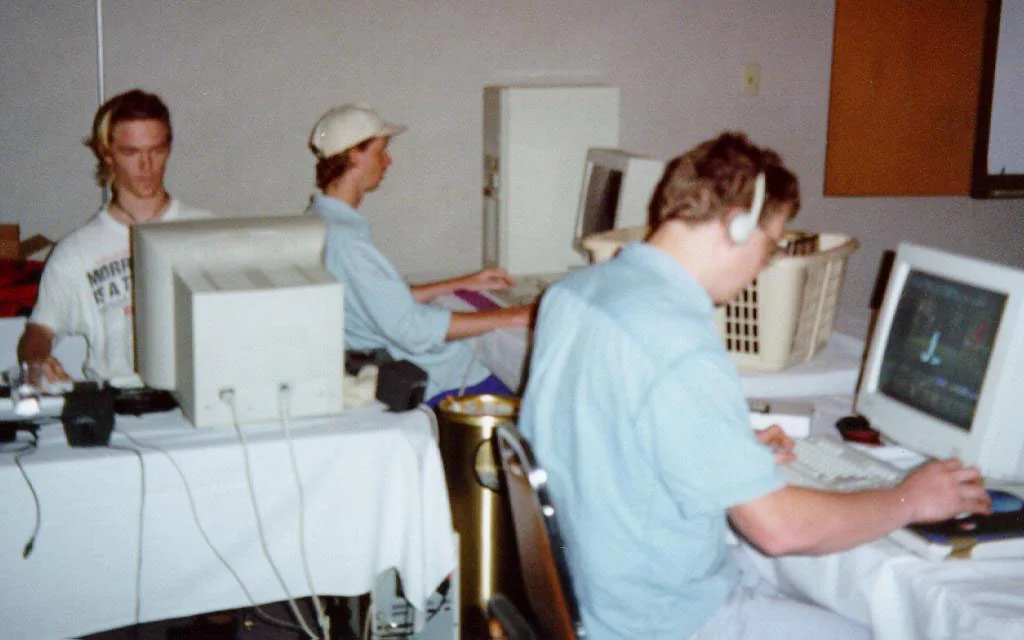
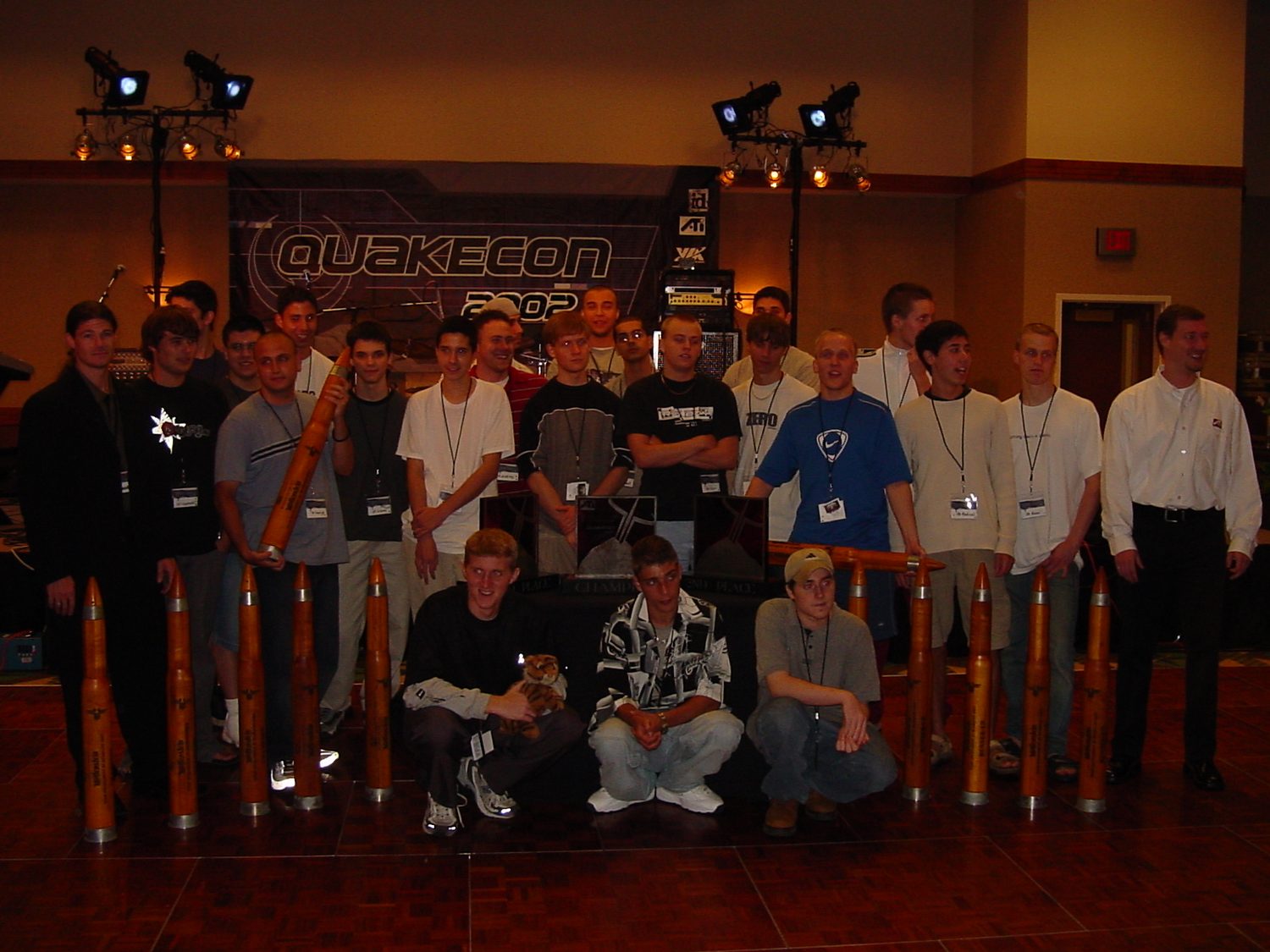
In 1996, the same year Quake shipped, players gathered in Texas for what became QuakeCon. id Software's current history describes the first event as a bring-your-own-computer gathering and Quake tournament attended by dozens of gamers in a Garland, Texas hotel. From that modest origin grew an annual institution identified by id today as North America's longest-running LAN party.

The BYOC format is important because it expresses PC gaming culture physically. Players do not merely buy admission and sit in identical tournament stations. They haul machines, monitors, keyboards, mice, cables, chairs, decorations and increasingly elaborate personal setups into a shared room. The network is infrastructure, but the people and their rigs are the spectacle.
Competitive Quake naturally became part of that culture. Duel especially fits a stage: two players, one map, instantly readable swings in control and a mechanical skill ceiling that remains visible even to spectators who do not know every item time. Team modes, community tournaments and later Quake titles broadened the program, while QuakeCon itself expanded into panels, announcements, exhibitors, charity activity and general Bethesda/id fandom.
The convention outlived every individual Quake client generation. That matters. A player could attend in the era of original Quake, Quake II, Quake III, Quake 4, Quake Live or Quake Champions and still recognize the same core ritual: people traveling to Texas to sit together on a very large network and play computer games. Technology changed; the social architecture remained.
By 2026, QuakeCon and Quake both reached thirty-year milestones. id's own anniversary material explicitly connects the 1996 Quake release with that first gathering and the continuing event. Few game-specific community institutions survive long enough to become part of the history they were originally celebrating.
Chapter 16 · Expanding the original
Scourge of Armagon, Dissolution of Eternity and the expandable Quake campaign
Quake's commercial life quickly expanded through official mission packs. Scourge of Armagon and Dissolution of Eternity added campaigns, maps, enemies and weapons while using the original game as a base. Their existence reinforced the same architectural idea that community mods exploited: Quake could load a different game directory and become a related but distinct experience.
The mission packs also widened Quake's design vocabulary. New weapons and enemy behaviors pushed encounters away from the precise balance of the base game. Their purpose was not to preserve competitive purity; it was to give experienced campaign players stranger toys and new threats. That makes them useful historical artifacts because they show how quickly designers were willing to stretch a system that had only just shipped.
Decades later, the official enhanced Quake release folded both mission packs back into the standard modern package, alongside later MachineGames campaigns. What had once been separately boxed expansions became chapters in a much larger historical edition. The effect is curatorial: a new player can move through multiple eras of Quake level design from one menu.
Chapter 17 · November 11, 1997
Quake II: the name stays, the universe changes
Quake II was released in 1997, but it did not continue the original Quake's Ranger-versus-eldritch-realms story. It introduced a new military science-fiction setting centered on humanity's war with the Strogg. That discontinuity established one of the oddities that still defines the franchise: “Quake” can refer to a family of mechanically and technologically related shooters without implying one perfectly continuous fictional universe.
The Strogg gave Quake II a clearer narrative enemy. Industrial installations, cybernetic enemies, objectives and interconnected unit structures created a campaign identity distinct from the first game's dreamlike episode-hopping. The player is not merely falling through slipgates into unknowable castles; the campaign frames progress as an assault through hostile infrastructure.
Technically, Quake II advanced id's engine architecture and networking while retaining the philosophy that game logic and tools should be exposed enough to support modification. id later released the Quake II engine source under the GPL, preserving the codebase in the same spirit as the original Quake release. The source tree documents a game that had already become more modular and more explicitly organized around client/server game code.
Multiplayer remained essential. Deathmatch and team play carried forward the resource-control instincts of Quake, while Quake II's own weapon balance and movement created a distinct competitive identity. The railgun in particular became inseparable from later Quake culture: high precision, instant feedback and spectacular punishment for exposed movement.
Quake II also became a platform for its own expansions and mods, including official mission packs The Reckoning and Ground Zero. The modern enhanced release now packages those campaigns together with Quake II 64 and MachineGames' Call of the Machine, turning the current edition into another multi-era archive.
Chapter 18 · December 5, 1999
Quake III Arena: the series stops pretending multiplayer is a side dish
Quake III Arena made an audacious structural decision: build the game around arena combat. There is a single-player progression, but it is fundamentally a ladder of matches against AI-controlled bots rather than a conventional narrative campaign. The arenas, weapons, movement and match rules are the product. id had watched several years of players turn Quake into a sport and responded with a sequel that begins from that premise.
The fiction is deliberately thin and useful. Warriors from different times and places are gathered to fight in arenas. That gives the roster permission to include radically different characters—including figures connected to earlier id games—without requiring a long campaign to explain them. The arena is the universe.
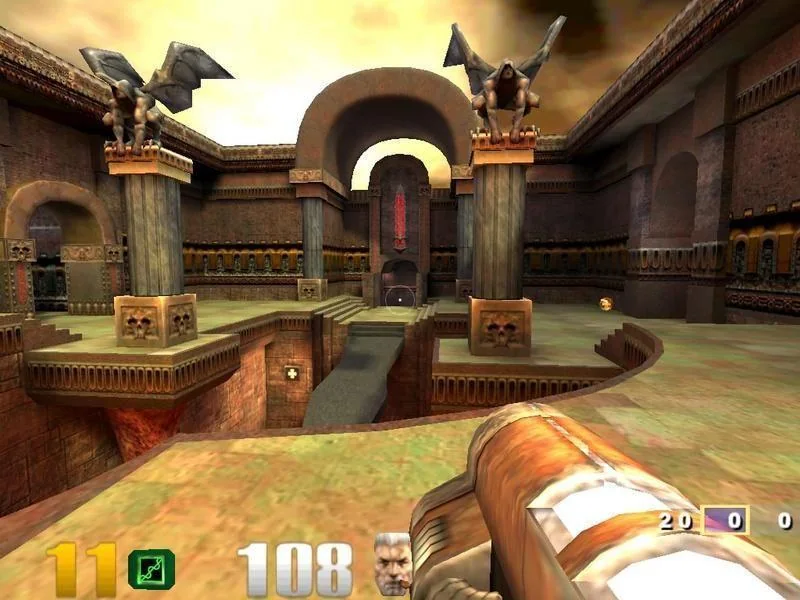
Quake III's renderer and tools represented another major id technology step. Curved surfaces, shader scripts, improved lighting effects and a flexible material system allowed arenas to look more elaborate than the hard-edged spaces of the first Quake. The later GPL source release includes not only engine and game code but also tools such as q3map and Q3Radiant material, exposing a large portion of the production stack.
Movement remained central but felt different from QuakeWorld. Strafe jumping and circle jumping became core high-level techniques. The railgun made long sightlines dangerous. Rockets controlled space and created splash pressure. The lightning gun rewarded sustained tracking. The result was a weapon triangle that emphasized different aim types: prediction, flick precision and continuous tracking.
The official Steam release today describes four foundational modes—free for all, team deathmatch, tournament/duel and capture the flag—and includes Team Arena. But the historical importance of Quake III is larger than its stock mode list because competitive mods and community maps would reshape how serious players experienced it.
Chapter 19 · The arena is refined by its players
OSP, CPMA, Rocket Arena, DeFRaG and the competitive ecosystem
Quake III shipped as a complete commercial game, yet serious multiplayer communities immediately began asking for more control: tournament administration, spectator tools, refined rules, alternate physics, richer statistics and modes built specifically around practice or competition. Mods answered those needs. The exact popularity of each project varied by region and era, but together they demonstrate a recurring Quake pattern—the community treats the official game as a strong baseline, not a boundary.
OSP became closely associated with competitive server features and tournament play. CPMA went farther, combining competitive infrastructure with movement and rules that deliberately evoked or extended earlier Quake traditions. Rocket Arena emphasized repeated combat rounds without the long resource-acquisition phase of normal deathmatch. These projects were not cosmetic modifications; they were arguments about what parts of Quake should be foregrounded.
DeFRaG performed the most radical extraction. It turned movement into a discipline of its own. Maps became obstacle courses for acceleration, strafe technique, weapon jumps and route optimization. A DeFRaG run can look almost unrelated to ordinary deathmatch, yet every skill comes from the same underlying obsession with Quake movement. The mod makes explicit what competitive players had already learned: traversing the map can be as technically demanding as shooting.
Custom maps multiplied alongside the mods. Quake III's visual language—jump pads, gothic halls, space platforms, industrial rooms—became raw material for thousands of arenas. Community standards emerged around spawn placement, item balance, trick jumps and spectator readability. Some maps were made for public chaos, others for duel, clan arena, CTF or movement practice.
This ecosystem explains why later projects such as Quake Live could not simply present untouched Quake III and call the job finished. Years of mods had taught players to expect conveniences, modes and competitive features that were no longer optional in practice.
Chapter 20 · Code as cultural preservation
The source-code releases turn commercial engines into public infrastructure
id Software's decision to release source code for older engines is one of the most consequential parts of Quake's long history. The original Quake source release covers WinQuake, GLQuake, QuakeWorld and GLQuakeWorld and places the code under the GNU General Public License. Carmack's accompanying note explicitly distinguishes engine source from copyrighted game data: developers can modify and redistribute GPL-compliant engine code, but the original commercial assets do not magically become free.
That distinction enabled source ports. A source port can modernize operating-system support, input, video modes, networking or rendering while still requiring legitimate game data. Different projects optimize for different goals: historical faithfulness, speedrunning compatibility, high-resolution effects, multiplayer, convenience or mod support. There is no single “correct” modern Quake engine because the source release allowed multiple philosophies to coexist.
Quake II followed with its own GPL source release. Quake III Arena's source was also released under the GPL, along with substantial tool code. These releases turned id's old engines into teaching material. A programmer can inspect prediction, snapshots, rendering, filesystem design, virtual machines, map formats and decades-old performance decisions directly rather than relying entirely on reverse engineering.
The releases also improved preservation. Operating systems stop supporting old APIs. Compilers change. Hardware disappears. Binary-only games can become trapped on the assumptions of their original era. Source code gives a community more options for carrying a game forward. Quake's continued availability on modern systems therefore comes from two parallel tracks: official commercial rereleases and community maintenance made possible by open engine code.
There is a philosophical thread in Carmack's original Quake source-release note as well. He contrasts the GPL release with earlier licensing approaches and encourages mod teams to share source rather than risk losing closed code. That is not merely a legal footnote. It describes a preservation ethic: software survives better when knowledge can escape the machine and company that originally produced it.
Chapter 21 · 2005
Quake 4: the Strogg war becomes a cinematic campaign
Quake 4 returned to the Strogg storyline rather than the gothic nightmare of the 1996 game. Developed by Raven Software in collaboration with id Software, it continued the military science-fiction branch established by Quake II. By 2005, expectations for a major first-person shooter campaign had changed. Fully voiced characters, scripted sequences, squad interaction, elaborate machinery and cinematic presentation were now normal ambitions, and Quake 4 leaned into that language.
The campaign's most famous sequence is the player's transformation through Stroggification. It takes the body-horror implications of Quake II's cybernetic enemy and makes them personal: the human soldier is processed through the machinery of the enemy. This is an example of how far the Quake name had traveled from the abstract slipgate horror of the original. The franchise could now contain a heavily narrated war story while still tracing its enemy lineage back to 1997.
Multiplayer, meanwhile, deliberately retained strong Quake III influence. That was sensible. By 2005 Quake III had become the competitive reference point, so a Quake sequel that ignored arena movement and weapons would have risked abandoning a large part of the audience that cared most about the name. Quake 4 therefore sits between two traditions: Quake II's fiction and Quake III's multiplayer expectations.
Its reception also illustrates a recurring problem for the series. “Quake” means different things to different players. For one player the essence is gothic single-player horror. For another it is Strogg fiction. For another it is duel. For another it is Clan Arena or CTF. Every sequel chooses which branch to emphasize, and every choice necessarily leaves some version of Quake in the background.
Chapter 22 · 2007
Enemy Territory: Quake Wars: Quake expands to class-based objective warfare
Enemy Territory: Quake Wars pushed the Strogg conflict into large objective-based team battles. Developed by Splash Damage with id Software involvement and technology, it fused the Quake II/Quake 4 universe with the class-and-objective structure associated with the Enemy Territory lineage. Instead of compact arena control, teams fought across larger battlefields using specialized roles, vehicles, deployables and sequential objectives.
The game is historically interesting because it demonstrates how elastic the Quake brand had become. Original Quake deathmatch strips combat down to players, weapons, items and map control. Quake Wars adds strategic layers on top: spawn logistics, class composition, construction, hacking, vehicles and coordinated objectives. Yet the Strogg, the weapons and id-tech heritage make it recognizably part of the same broad family.
Quake Wars also shows how ideas first explored by mods had become mainstream commercial design. Class-based multiplayer no longer needed to be a hobbyist experiment inside QuakeC; by the late 2000s it could anchor a large retail shooter. The historical loop is striking: Quake provided fertile ground for class mods, the industry absorbed those lessons, and a later Quake-branded game returned with classes as a central feature.
Chapter 23 · 2009–present
Quake Live: Quake III is rebuilt as a service, then becomes a community server game
Quake Live began as an attempt to make Quake III-style arena combat easier to enter through a web-oriented service. Instead of expecting a new player to buy an old boxed game, patch it, learn server browsers and install competitive mods, Quake Live wrapped familiar Quake III fundamentals in accounts, matchmaking-era expectations, persistent statistics and a curated pool of arenas and modes.
The official Steam listing identifies Quake Live as a 2010 id Software release and describes it as a multiplayer-focused successor to Quake III Arena with more than 100 arenas, career statistics, match history and over a dozen modes. That breadth is crucial. Quake Live did not preserve only duel. It became a home for free-for-all, team deathmatch, clan arena, capture the flag, freeze tag, domination and other forms of play that had accumulated around the Quake III ecosystem.
Clan Arena deserves special mention because it expresses a very different philosophy from item-control duel or team deathmatch. Players begin armed and armored, teams fight round-based elimination, and the resource economy inside the map largely disappears. That shifts emphasis toward team positioning, coordinated damage, aim and surviving engagements. To a purist it can look like Quake with one of its deepest systems removed; to its devotees that removal is exactly what makes the mode so direct.
Freeze Tag similarly demonstrates Quake's willingness to let a simple rule transform familiar combat. A fragged opponent becomes frozen rather than simply respawning, and teammates can restore one another. Suddenly positioning after a kill matters differently, fights create frozen geography, and rescuing a teammate becomes an objective inside ordinary weapon combat.
Quake Live's business and delivery model changed over time. The browser-centric identity receded, Steam became the practical home, and the game ultimately settled into the form that matters to today's long-lived communities: a compact standalone arena FPS with dedicated/community server support, Workshop content, a large inherited map pool and enough server-side flexibility for administrators to build their own local cultures.
That last phase may be less glamorous than a giant publisher launch, but it is historically important. A service designed to make Quake accessible eventually became another durable piece of software that communities could keep running themselves. In 2026, that is why a small group in one city can run its own FFA, Clan Arena, Freeze Tag, Duel, TDM and Capture the Flag servers, add commands and statistics, maintain custom rating systems and create a local identity around a game whose mechanical roots are more than a quarter-century old.
Chapter 24 · 2017–present
Quake Champions: arena fundamentals meet character abilities
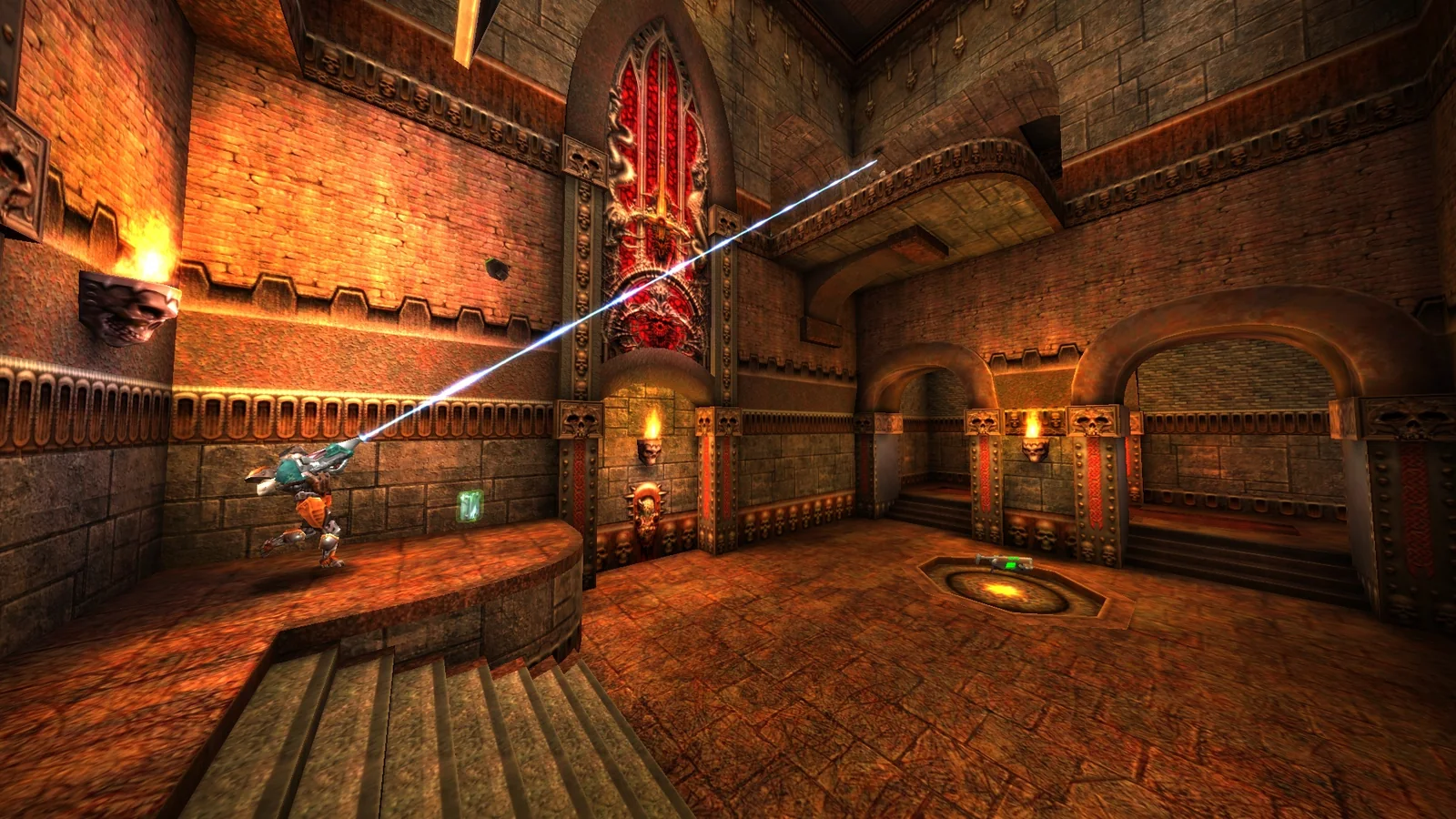
Quake Champions entered Steam Early Access in August 2017 and received its full Steam release in August 2022. Its central idea is visible in the official description: combine the dark mythos of the original Quake with the skill-based arena competition of Quake III, then add Champions with distinct attributes and abilities. That formulation is almost a miniature history lesson. The game consciously joins two branches of the franchise that had spent years apart.
The classic weapon set remains central. Rockets still reward prediction and splash placement. The lightning gun still rewards sustained tracking. The railgun still punishes exposed movement. Rocket jumping and high-speed traversal remain part of the identity. On top of that foundation sit champion-specific health, armor, movement properties and abilities.
That champion layer has always been the most obvious departure from Quake III's ideal of symmetrical starting bodies. It creates matchup knowledge and strategic differentiation before a weapon is picked up. For some players that adds useful variety and gives the franchise a modern character-facing identity. For others it complicates the purity that made Quake III or Quake Live attractive. The tension is not accidental; it is the design proposition.
Quake Champions also kept elite duel visible during an era when arena shooters were no longer the center of the commercial multiplayer market. Its tournament scene placed familiar Quake skills—movement, timing, aim, adaptation—on modern broadcasts with modern production. Even players who preferred older clients could recognize the lineage immediately.
The official current Steam page still describes Quake's “signature rocket jumping, skill-based competition, and incredible speed” as intact. That wording is a useful definition of what the publisher believes cannot be removed without ceasing to feel like Quake.
Chapter 25 · 2021–2026
The modern rereleases: old Quake becomes a curated living archive
In 2021 the original Quake received a major enhanced rerelease for modern platforms. The current official edition preserves the original game while adding modern resolution and widescreen support, visual options, online and local multiplayer features, cross-platform play and curated add-ons. More importantly for history, it gathers multiple generations of Quake content in one supported package.
MachineGames contributed Dimension of the Past and then Dimension of the Machine, demonstrating that a modern AAA studio could return to the constraints and aesthetics of a 1996 game without treating them as a joke. id's rerelease QuakeC repository documents codebases for the original campaign, both original mission packs, Capture the Flag and MachineGames content, with localization and bug-fix changes necessary for the contemporary edition.
In 2023 Quake II received a similarly ambitious enhanced release. It combines the original campaign, The Reckoning, Ground Zero, Quake II 64 and MachineGames' new Call of the Machine. It also adds modern multiplayer/co-op conveniences and crossplay. The result is not just emulation of a 1997 executable. It is an editorial package that treats different ports and expansions as parts of one historical object.
Then, in August 2026, id Software and MachineGames celebrated Quake's 30th anniversary with Dawn of the Machine, a new 19-map episode released as a free update to current Quake owners. MachineGames described a dedicated internal “Quake Club” whose members range from people who had designed Quake levels since the 1990s to newer mappers who entered the scene much later.
The 2026 update goes even further as preservation. MachineGames' behind-the-scenes account says the update includes an id Vault showing early game builds, original-development levels, textures and models. In other words, the commercial game now contains an archival layer devoted to its own making. That is a rare endpoint for software: the current version is simultaneously a playable game, a platform for new maps, and a museum of discarded prototypes.
The 30th-anniversary content also explicitly thanks community tool authors and the wider mod scene. MachineGames called out the TrenchBroom editor and modern compiling tools by name. That acknowledgment closes a loop opened in 1996. id's tools helped create a community; thirty years later, community tools help a professional studio create official Quake.
Chapter 26 · The game refuses to become “finished”
The modern mapping renaissance: thirty-year-old constraints, new ideas
One of the most surprising facts about Quake in the 2020s is not that people can still run it. Preservation can accomplish that for many old games. The surprise is that people are still making ambitious new content for it. Modern map editors, source ports and compilers reduce historical friction while leaving the central brush-based design language intact.

TrenchBroom is emblematic. It gives mappers a modern direct-manipulation interface for building Quake-style brush geometry. The editor does not erase the old format; it makes that format pleasant to work with on contemporary systems. Modern compilers similarly remove or relax old limits, improve diagnostics and support maps whose scale would have been unreasonable on the hardware that shipped with Quake.
This has produced a fascinating inversion. In 1996, mappers were constrained by what a Pentium and software renderer could draw. In 2026, a mapper can intentionally choose the same low-resolution textures, chunky models and brush geometry while building spaces vastly more complex than the original hardware could tolerate. “Retro” becomes an aesthetic decision rather than a technical prison.
Community projects such as Arcane Dimensions, Alkaline, Copper and large map jams demonstrate different approaches. Some extend monsters and weapons. Some emphasize compatibility and subtle rules. Some push scale and spectacle. Some deliberately build tiny maps under severe self-imposed limits. The shared engine family lets all of those philosophies coexist.
Official Bethesda interviews with modders repeatedly emphasize the openness of the current Quake scene. Veteran creators can return after decades; new creators can start with modern tools; and official rerelease add-on menus can expose selected community work to players who would never browse an old FTP archive. The path from hobby map to audience is different from 1996, but the creative loop is recognizably the same.
Chapter 27 · The durable core
Why Quake lasts
Quake survives because several forms of depth overlap without requiring one another. A player can enjoy the original campaign without caring about duel. A dueler can obsess over item timing without caring about gothic lore. A mapper can spend months on geometry without becoming a high-level competitor. A programmer can study the engine without finishing Episode One. A server operator can build a community around Clan Arena or Freeze Tag. A speedrunner can treat the entire game as a physics problem. These are not separate fandoms glued to a logo; they keep feeding one another.
Its mechanics are legible
Quake weapons communicate clearly. A rocket is a visible projectile with splash. A rail shot is immediate precision. Lightning is sustained contact. Armor and mega health are physical items in physical places. There are deep exceptions and advanced interactions, but the basic grammar can be seen. That makes improvement satisfying because the player can usually identify what went wrong.
Its movement rewards obsession
A new player can move with WASD and jump. An expert can turn the same hallway into a speed line. The game therefore supports competence layers without changing the rules menu. Movement technique is learned through the hands, and that knowledge transfers imperfectly but meaningfully across Quake descendants.
Its maps are small enough to memorize and deep enough to study
Great arena maps become mental objects. Players remember not only rooms but routes, sounds, timings, sightlines and likely opponent choices. Because maps are replayed for years, tiny geometry decisions matter. This is the opposite of disposable content. Familiarity increases value.
It can be administered
Dedicated servers, console variables, mods, map rotations and community tools let players create places with house rules and identities. That matters for longevity. Matchmaking can find opponents efficiently, but a persistent community server can accumulate memory: regulars, rivalries, favorite maps, customs and local etiquette.
It can be modified
Quake has never been only what id shipped. The community can fix, port, extend, rebalance, restyle and repurpose it. Source releases dramatically strengthened that ability. When official development pauses, community development does not have to stop.
It has no single “correct” era
Some players mean QuakeWorld when they say Quake. Some mean Quake III. Some mean Quake Live. Some care about Quake II's Strogg campaign. Some entered through Quake Champions. Some discovered the original through the 2021 rerelease. That fragmentation can make franchise direction difficult, but it also prevents the history from collapsing into one obsolete executable.
Chapter 27A · Deep dives
The anatomy of Quake culture: the systems around the shooting
The broad chronology explains when the games arrived. It does not fully explain what it feels like to live inside Quake for years. Quake culture grew around habits that are almost invisible in a conventional release history: learning the sound of an armor pickup through a wall, knowing the exact width of a rocket splash danger zone, shaving a turn until a jump lands one step sooner, recognizing a map from the first corridor, recording demos, comparing configuration files, keeping a favorite server alive, arguing over weapon balance, and discovering that a player who seems impossibly fast is not cheating at all. They have simply learned a movement system that the manual barely describes.
These details matter because Quake's historical importance was never only a sequence of products. It became a set of practices. Those practices migrated between Quake, QuakeWorld, Quake II, Quake III Arena, Quake Live, Quake Champions and community projects. The values changed from branch to branch, but an experienced player could often recognize the family resemblance in seconds.
Weapons as a language rather than a loadout
Many shooters give the player several weapons because variety is entertaining. Quake's best multiplayer rulesets turn weapons into a vocabulary. The point is not merely that the rocket launcher, lightning gun, railgun, shotgun, grenade launcher and plasma-style weapons have different damage numbers. They occupy different geometric and temporal jobs. A rocket can be aimed at a floor, wall, doorway or landing point instead of at a body. Splash damage lets the shooter threaten space. Projectile travel time rewards prediction. Knockback can disrupt an opponent's movement even when the shot is not lethal. The same rocket can be a weapon, a mobility tool, an area-denial device, a finishing shot or a gamble that trades health for position.
Hitscan weapons speak a different dialect. Lightning-style weapons reward sustained tracking and the ability to remain on target while both players move violently. Rail-style weapons reward a precise instant: a narrow line between shooter and opponent at one particular moment. Shotguns can punish exposed low-health targets without spending premium ammunition. Grenades can make a route temporarily unpleasant even when nobody is visible. In Quake III-derived games the plasma gun adds a rapid projectile stream that can be used for direct damage, spam, close-range pressure and movement tricks. Because these weapons solve different problems, switching is not administrative overhead. Weapon choice is tactical reasoning expressed through the hands.
This is why discussions of Quake balance so quickly turn into discussions of maps. A rocket launcher in a tight stairwell is not the same strategic object as a rocket launcher across a huge atrium. A railgun becomes more oppressive when long sightlines are easy to hold; a lightning gun becomes more valuable when fights can be forced into mid-range tracking distances. Ammunition placement matters too. A weapon can be intentionally strong if the map makes acquiring it dangerous, limits ammunition, or places its best firing positions far from major health and armor. The weapon system and level geometry form one design.
Veteran players therefore learn to read an opponent through weapons. A missed rail shot reveals a reload window. Rockets fired from below may announce that the attacker is trying to pop a target into the air. Grenades bouncing through a doorway may say that the shooter does not know exactly where the opponent is but wants to delay pursuit. The sound of a weapon can disclose location before the projectile is seen. Ammunition consumption can become information in long duels. Even aim style becomes legible: one opponent wants repeated rail peaks; another wants to collapse the distance and attach with lightning; another keeps manufacturing rocket angles where every dodge is expensive.
Quake's weapons are memorable partly because they are not designed to make one another obsolete. Their usefulness overlaps without becoming identical. The result is a combat system where mastery is not simply "get the best gun." It is "get the right set of tools, preserve enough ammunition to use them, engineer fights that favor those tools, and change tools fast enough that the opponent cannot stabilize." That is one reason watching an expert can look less like superior aim than superior grammar.
Items, timing and the invisible economy of the map
A newcomer often evaluates a Quake fight by the scoreboard: who has more frags? Experienced duel and team players are usually watching another economy at the same time. Health, armor, major powerups, ammunition, weapon access and position circulate through the map. The scoreboard records the visible result; resource control helps explain why the result became possible.
A major item is powerful because it changes future fights, not just the current health total. Taking armor can allow a player to survive a direct rocket that would otherwise end a confrontation. Taking a large health pickup can turn an aggressive route from reckless into reasonable. Denying the same pickup deprives the opponent of exactly that opportunity. In item-control modes, a pickup therefore has two values at once: what it gives you and what it prevents the other player from receiving.
Timing transforms memorization into strategy. If a valuable item returns on a predictable schedule, then the moment it was collected becomes future information. Strong players do not merely remember a number in isolation. They integrate that number with route length, spawn state, weapon state, opponent location and risk. Arriving at an item at the nominal second can still be wrong if the approach gives the opponent a perfect rocket angle. Arriving early can be useful if it creates a favorable trap; arriving late can be correct if contesting would sacrifice more than the item is worth.
That produces one of duel's central asymmetries: being "in control" and being "out of control." The player with more stack and better access can often take direct routes and force exchanges. The disadvantaged player may need to steal smaller resources, deal damage without committing, set traps, listen for cues, or deliberately concede one major item in order to contest the next. Good out-of-control play is not passive. It is an attempt to convert information, positioning and damage into a future moment when the resource hierarchy can be reversed.
Team modes multiply the economy. In TDM, a single player's need for armor must be weighed against a teammate's condition and role. Communication can include item timing, enemy stack estimates, weapon drops, route warnings and requests to leave ammunition. A team that treats every pickup as first-come-first-served may lose to a team whose mechanical aim is no better but whose resources are distributed deliberately. Quake's minimal interface hides an unexpectedly social logistics problem.
Map control also explains why sound is so consequential. Pickups, jumps, lifts, teleporters, weapon fire and pain sounds can reveal where resources are being consumed. A player may infer not only "the opponent is near that room" but "the opponent just took that armor, so another resource is now the likely destination." The map becomes a clock and a probability field. At high levels, the empty space between visible encounters is full of decisions.
Duel: two players, one map, no place to hide from your own decisions
Duel is Quake reduced to a severe form: two players share a compact resource system and every mistake has an identifiable owner. There is no teammate to rescue a bad engagement, no crowd to distract the opponent, and no large-team chaos to blur causality. That makes duel unusually revealing. Aim matters, but so do timing, route selection, patience, spawn knowledge, damage calculation, sound interpretation and the ability to predict what another human will do after learning your habits.
The opening seconds can matter enormously because initial weapon and item access establishes the first control state. Yet a duel is rarely decided by one scripted opening alone. Once the match develops, both players are continually updating imperfect models of the other. Where did they spawn? What did they pick up? Which sound was real information and which possibility should be discounted? Will they challenge a major item or use that expectation to steal a weapon elsewhere? Do they know that you know the timing?
Score also changes rational behavior. A player who is behind late in the match may need to accept risks that would be foolish at even score. A player protecting a lead can sometimes trade space for time. That does not mean "run away" in a simplistic sense; giving away too much map control can create exactly the stack the opponent needs for a comeback. Time itself becomes a resource, and the score determines its value.
Because duel is so information-dense, famous matches are remembered as narratives. One player establishes control, the other steals a major item, a risky rocket connects, a spawn produces an opportunity, a lead changes hands, and suddenly an arena that has existed for years feels new. This is why old maps can remain tournament-worthy. The geometry is fixed; the strategic story is not.
FFA and the democratic chaos of public Quake
Free For All is sometimes treated as the least serious multiplayer mode because its crowded fights contain randomness and third-party damage. Historically, however, FFA is one of Quake's most important social forms. It is the mode many players encounter first. It is forgiving of uneven attendance: one person can join, another can leave, the match continues. It creates instant action without requiring teams, brackets or synchronized readiness. A public FFA server can become a town square.
The apparent chaos still rewards knowledge. Spawn survival matters. Route choice matters. Reading where fights are likely to happen matters. Efficient finishing matters because damaging one opponent only to have somebody else take the frag changes the value of an engagement. Major items are useful, but contesting them in a packed server may invite fire from several directions. Players learn when to enter a fight and when to let two opponents damage one another first.
FFA also produces a particular kind of server identity. Regulars learn one another's names and tendencies. Certain maps become associated with the local population. The strongest player may become a benchmark rather than merely a winner. New players can measure improvement by surviving longer against recognizable opponents. Because joining requires little coordination, FFA is often where an aging game's remaining population can still feel unexpectedly alive.
Team Deathmatch, CTF, Clan Arena and Freeze Tag: Quake is not one multiplayer game
Team Deathmatch takes the individual resource game and adds shared responsibility. Traditional item-control TDM asks a team to coordinate weapons, armor, powerups and positions while maintaining combat pressure. Players may specialize informally by map position or weapon access. A death can have consequences beyond one frag if it drops a weapon, loses control of a powerup route or forces teammates to spend resources rebuilding a stack. Voice communication makes the invisible economy explicit: timers, enemy positions and requests become a second stream layered over movement and aim.
Capture the Flag changes the geometry of purpose. A map now has homes, routes between homes, escape paths and moments when defending a location is more valuable than chasing a frag. Individual mechanics still matter, but they are subordinated to flag state. A spectacular kill in the wrong place can be strategically irrelevant; a player who deals little damage may still save a capture by delaying an attacker for two seconds. CTF helped prove very early that Quake's movement and weapons could support objective play, not only deathmatch.
Clan Arena removes much of the pickup economy and front-loads equipment, turning the round into a team fight. That makes positioning, focus fire, damage efficiency and survival more prominent while reducing the need to learn item routes before participating. For many Quake Live communities this accessibility is a strength: players can spawn with the tools and immediately practice fighting. Purists who love item control may see it as a different sport, which is exactly the point. The same movement and weapon grammar can support another structure.
Freeze Tag adds another transformation. A defeated player becomes a frozen teammate who can often be restored through team action, so a "kill" is not necessarily a permanent removal from the round. The state of bodies on the map becomes tactical information. A team may need to choose between pursuing damage and rescuing frozen players. Comebacks can emerge from coordinated thawing. What looks like a novelty mode can generate deep positional play because the map contains both enemies and recoverable teammates.
Rocket Arena, Instagib, race/movement modes and many community inventions push the same principle farther. Remove item control, exaggerate one weapon, isolate combat into rounds, turn movement into a stopwatch challenge: each modification reveals a different property of the base mechanics. Quake's history is therefore not a linear search for the one true ruleset. It is repeated experimentation with what happens when a highly expressive movement-and-combat system is placed inside different social contracts.
Demos: Quake learns how to remember itself
Recorded demos are one of the least glamorous technologies in Quake's history and one of the most culturally important. A demo can preserve a match, a speedrun, a trick, a tournament final, a suspicious moment or a personal best. Because the recording can be replayed inside a compatible client, it captures game-state information in a way that ordinary video does not. Historically this made demos compact, distributable artifacts at a time when downloading full-motion video over consumer internet connections was impractical.
Demos allowed expertise to travel. A player in one country could download a recording from another, watch routes and aim choices, and study a style they had never seen on a local server. Competitive communities could archive finals. Speedrunners could submit evidence. Mod developers could reproduce bugs. Server administrators could investigate accusations. Frag-movie creators could mine recordings for spectacular moments and then edit them into a new form.
They also changed spectatorship. A match did not have to vanish when the server disconnected. It could become an object of analysis. Players could rewind conceptually by replaying from the beginning, compare perspectives when available, and preserve performances long before livestream platforms made game footage ubiquitous. Quake's demo culture is part of the ancestry of modern esports VOD review, even though the technologies differ.
The same recording mentality fed machinima. Once players realized that the engine could replay staged action, a first-person shooter became a camera system and virtual set. The famous early Quake films mattered not because they looked like contemporary cinema—they obviously did not—but because they demonstrated a conceptual shift: a game engine could produce authored narrative footage. Later engines and tools would make that idea commonplace.
Configuration culture: the text file behind the player
Classic PC Quake is unusually inspectable. Console variables, binds and configuration files expose large parts of the player's interaction with the engine. That openness produced a culture in which a person's setup could become almost as distinctive as a physical sports player's equipment. Mouse sensitivity, field of view, crosshair, weapon binds, network variables, graphics settings and HUD preferences could be tuned and shared.
Some of this is ordinary personalization. Some of it becomes competitive engineering. A player wants a bind that selects a weapon instantly rather than cycling through an inventory. Another wants a key to issue a team message while preserving movement. Another adjusts visuals to prioritize enemy readability. Another maintains separate configs for different Quake branches. The command console turns the game into something closer to an instrument panel than a sealed appliance.
This culture creates recurring arguments about legitimacy. At what point does a useful bind become automation? Which visual settings improve accessibility and which erase intended information? Should tournament rules restrict certain variables? Those debates differ by game and era, but they arise from the same structural fact: the engine gives players substantial control over presentation and input.
Config culture also helps preservation. When communities know how to start dedicated servers from command lines, define rotations, load mods and diagnose variables, they are less dependent on a publisher-operated matchmaking service. Knowledge is distributed among administrators. Documentation may be messy and tribal, but it exists in thousands of copied configs, forum posts, scripts and server installations. The game's infrastructure becomes partly community-owned in practice even when the trademarks and data remain commercial property.
Dedicated servers and the social geography of a server browser
A persistent dedicated server is more than a process listening on a network port. Over time it can become a place. The hostname is remembered. Regulars know when it fills. Administrators establish rules and ban obvious abuse. Map rotations develop reputations. Custom votes, sounds, statistics, ratings and plugins create local texture. A player can disappear for months and return to recognizable names.
This differs from anonymous matchmaking. Matchmaking optimizes for quickly assembling suitable opponents; that is useful and often necessary at large scale. A community server optimizes less efficiently but accumulates history. The same people encounter one another repeatedly. Skill gaps become personal challenges. House rules emerge. A particularly strong player can function as a local boss fight. A newcomer who stays long enough becomes part of the place.
The server browser also gives the population a visible geography. You can see modes, maps, ping, occupancy and sometimes familiar server names before joining. Empty servers are visible too, which can be depressing in an old game but also honest. A community can decide to seed a server, organize a regular night or run bots until humans arrive. Persistence is not automatic; it is an administrative act.
For Quake Live in particular, the survival of community-operated servers is part of why the game can remain socially meaningful long after its commercial peak. The technology allows local communities to add statistics, rating systems and quality-of-life plugins without rewriting the game itself. The result resembles early Quake culture in an important way: players do not merely consume a central service. They operate pieces of the ecosystem.
Maps become cultural memory
Multiplayer maps occupy a strange place between architecture and rulebook. A good map establishes distances, cover, vertical relationships, weapon access, resource cycles and possible encounters. But after thousands of matches it acquires a second layer made of remembered events. A staircase is where a famous comeback happened. A teleporter exit is where everyone knows not to stand. A jump becomes named after a player or a trick. An arena can outlive the hardware, renderer and distribution service that first presented it.
Quake's brush-based geometry helps make spaces learnable. Rooms often have strong silhouettes and functional identities. Vertical connections matter. Teleporters and jump pads can create non-Euclidean strategic relationships: two places that are far apart in visible architecture may be one instant apart in the movement graph. Item placement adds periodic reasons to traverse the same spaces differently.
Map longevity changes design evaluation. A visually impressive map may be forgotten if its routes produce repetitive fights. A comparatively plain map may survive for decades if it continually generates decisions. Competitive communities can become conservative because replacing a known classic means abandoning years of accumulated knowledge. At the same time, new maps are essential because they test whether players understand principles or merely routines.
The original Quake mapping scene and the later Quake III/Live workshop ecosystem show both sides of this culture. The tools invite endless creation, while communities repeatedly converge on a smaller canon for serious play. That tension—abundance in creation, selectivity in competition—is healthy. It allows Quake to be both laboratory and sport.
LANs, QuakeCon and the physical reality behind an online game
Quake is remembered as an internet milestone, but much of its emotional history is physical. LAN play removes much of the latency uncertainty that shaped early dial-up multiplayer. More importantly, it puts the person behind the nickname in the same room. Towers, CRTs and later flat panels, network switches, extension cords, folding tables, energy drinks, sleeping bags and miles of cable turned digital competition into an event with weight and noise.
The first QuakeCon in 1996 grew directly out of that culture. The official id anniversary history describes dozens of gamers gathering at a hotel in Garland, Texas for a bring-your-own-computer event and Quake tournament. Over time QuakeCon became much larger, but the BYOC remained symbolically central because it preserves the idea that the audience is not merely watching a publisher presentation. They bring machines and become the network.
LAN culture also affected competitive legitimacy. Early online matches could be distorted by radically different connections. A LAN final puts players on a more controlled network and turns remote reputations into face-to-face tests. Spectators can react in the room. Rivalries gain human texture. Players meet modders, administrators and opponents they previously knew only by aliases.
That physical continuity helps explain QuakeCon's unusual durability. The software catalog changes, ownership changes, hardware changes, and the proportion of attendees actively playing Quake changes. Yet the event name still invokes the game that made the original gathering possible. Quake became not just a title but a banner under which a PC gaming community could assemble.
Source ports, compatibility and the difference between preservation and petrification
Software does not survive merely because its files still exist. Operating systems change, graphics APIs disappear, display expectations change, security assumptions evolve and old binaries stop behaving reliably. Quake's source-code releases gave preservation a powerful advantage: programmers could adapt engines rather than only emulate an opaque executable.
id's GPL release explicitly includes the complete source for WinQuake, GLQuake, QuakeWorld and GLQuakeWorld while keeping the original game data under its original copyright terms. That distinction is fundamental. The engine can be studied, modified and redistributed under the license; the commercial art, maps and other data are a separate matter. This structure encouraged ports that use legally obtained game data while modernizing the program around it.
Different source ports pursue different goals. Some aim for visual fidelity and conservative behavior. Some add high-resolution rendering, modern input, widescreen support and quality-of-life features. Some extend engine limits so contemporary maps can become enormous. Some focus on competitive networking. Because source is available, disagreement does not require one winner. Multiple interpretations can coexist.
Preservation therefore becomes active rather than frozen. A preserved Quake can accept bug fixes, new operating systems and better tooling while still executing content authored decades ago. That same compatibility lets new content target old concepts. A mapper in 2026 can build for a thirty-year-old game format using a modern editor, compile with modern tools, run the result in a modern source port and still participate in a lineage recognizable to someone who mapped in 1996.
Quake III's GPL release broadened the educational value further by exposing renderer, game code, operating-system layers, map compilation, Radiant tooling, bot-related components, a bytecode toolchain and more. Source release did not merely preserve a product. It preserved a set of engineering ideas in executable form.
Esports before “esports” became a normal word
Quake's competitive significance is sometimes compressed into a few famous anecdotes, but the deeper contribution is structural. It offered a game whose skill could be observed, repeated, recorded and compared. LAN tournaments, leagues, ladders and demo archives provided the scaffolding for recognizable competitive careers. Players developed reputations that crossed individual servers. Spectators learned what elite play looked like. Sponsors and event organizers had something fast, legible and technically demanding to present.
Duel is particularly suited to star-making because responsibility is concentrated in one player. Team modes, however, demonstrate another side of early esports: communication, roles, map systems and organizational depth. The Quake lineage therefore supplied both individual and team competitive traditions.
As newer esports became commercially larger, Quake moved from center stage toward a specialist position. That transition can make its continuing competition more impressive, not less. A mature scene cannot rely on novelty. It survives because participants still find the game worth mastering and viewers can still appreciate the speed of decision-making. Quake Champions gave that tradition a contemporary official tournament platform; Quake Live and older Quake branches continued to sustain their own events and community competitions.
The most enduring competitive legacy may be conceptual. Quake helped normalize the idea that a first-person game could be practiced like a sport: maps studied, mechanics drilled, recordings reviewed, opponents scouted, settings standardized and championships contested in front of spectators. Modern esports inherited that assumption so completely that it can be easy to forget how novel it once seemed.
Quake's influence is larger than the Quake franchise
Direct lineage is easy to document through engine families, source code and developers. Broader influence is harder because game design rarely travels through one clean family tree. Still, several Quake-era ideas became ordinary enough that their historical novelty is easy to miss: mouse-driven 3D aiming, true vertical spaces, client/server internet play, downloadable modifications, dedicated servers, console configuration, hardware-accelerated 3D, recorded demos, spectator-minded competition and user-created maps distributed online.
Not every one of those ideas originated uniquely in Quake, and a responsible history should resist turning the game into the inventor of everything. Quake's importance is often that it assembled technologies and practices into one influential, widely studied platform. The engine became a foundation for licensed games. The mod scene trained designers and programmers. The competitive scene trained organizers and players. The source releases trained another generation of programmers. The mapping scene kept demonstrating what could be built from simple solids, entities and light.
Influence also travels through taste. Quake taught generations of players that speed itself can be depth, that a map can be memorized without becoming exhausted, that weapons can be movement tools, that low-latency control is an aesthetic property, and that mastery may live in interactions never explained by a tutorial. Later games can reject those values and still be responding to a landscape Quake helped shape.
Thirty years later, the most convincing evidence of influence is not a list of games that borrowed a feature. It is how normal Quake's once-strange assumptions now feel. A 3D engine as a platform, players modifying rules, online competitive identity, community-run servers, broadcast matches, downloadable maps, source ports, archived demos: much of that is now part of the vocabulary of PC gaming. Quake belongs to the period when that vocabulary was being invented in public.
Chapter 28 · Master timeline
Quake in chronological order
Chapter 29 · Vocabulary
A compact Quake glossary
dm often signals a multiplayer arena.Chapter 30 · Research notes
Primary sources, official material and community memory
This history deliberately favors first-party and primary material wherever practical: id Software's own source repositories and release notes, official Bethesda/id pages, current official store listings, and John Romero's firsthand development recollections. Community sources are used to describe continuing community memory or practice, not to silently override primary documentation.
A thirty-year software history contains naming changes, ports, regional releases and community conventions. Dates below are tied to the cited official/primary source where possible; some community phenomena are described without pretending there was a single formal “release moment.”
Core first-party / primary references
- id Software — official studio history and QuakeCon description
- id Software — Quake GPL source release, including WinQuake, GLQuake, QuakeWorld and GLQuakeWorld.
- id Software — QuakeWorld release notes.
- id Software — Quake tools source release.
- id Software — Quake II GPL source release.
- id Software — Quake III Arena GPL source release.
- id Software — Quake rerelease QuakeC source.
- Official Quake Steam listing — release date and current enhanced-edition features.
- Official Quake II Steam listing — release date and current enhanced-edition contents.
- Official Quake III Arena Steam listing — release date, modes and Team Arena.
- Official Quake Live Steam listing — official release date, modes, arenas, stats and current product description.
- Official Quake Champions Steam listing — Early Access/full release dates and current game description.
- John Romero — “Happy 20th Birthday, Quake”, with firsthand discussion of Quake's evolving pre-release design.
- John Romero — “QTest was Ground Zero”, firsthand QTest/networking recollection.
- John Romero — Quake sketches.
- John Romero — Quake 1's Player Speed.
- John Romero — Quake map source release.
- id Software 35th anniversary history — official 1996 Quake/QuakeCon overview.
- id Software — Quake 30th Anniversary Update.
- MachineGames/id — Dawn of the Machine behind the scenes, including Quake Club, the id Vault and community-tool acknowledgments.
Community perspective consulted
Current Quake and Quake Live community discussions were also checked for how players describe the living ecosystem—especially QuakeWorld, original Team Fortress preservation, public servers and the divide between current clients. Those observations were treated as community testimony rather than authoritative release documentation.
This page is an unofficial community history and is not affiliated with id Software, Bethesda Softworks, ZeniMax or Microsoft. Quake and related names are trademarks of their respective owners.
Image sources & credits
Quake Live and Quake III Arena gameplay images are official store screenshots from id Software/Bethesda Softworks via Steam. The QuakeCon 1996 photograph is © QuakeCon and reused under CC BY 2.0 via Wikimedia Commons.
Photo credits
Photographs on this page come from Wikimedia Commons and are reused under their respective free licences. No images on this site are AI-generated.
- QuakeCon 1996 - 33.jpg — QuakeCon, CC BY 2.0
- QuakeCon 1996 - 41.jpg — QuakeCon, CC BY 2.0
- QuakeCon 1998 - 101.jpg — QuakeCon, CC BY 2.0
- Awards Ceremony - QuakeCon 2002 - 10.jpg — QuakeCon, CC BY 2.0
- John Carmack GDC 2010.jpg — Official GDC, CC BY 2.0
- John Romero GDC 2023.jpg — Official GDC, CC BY 2.0